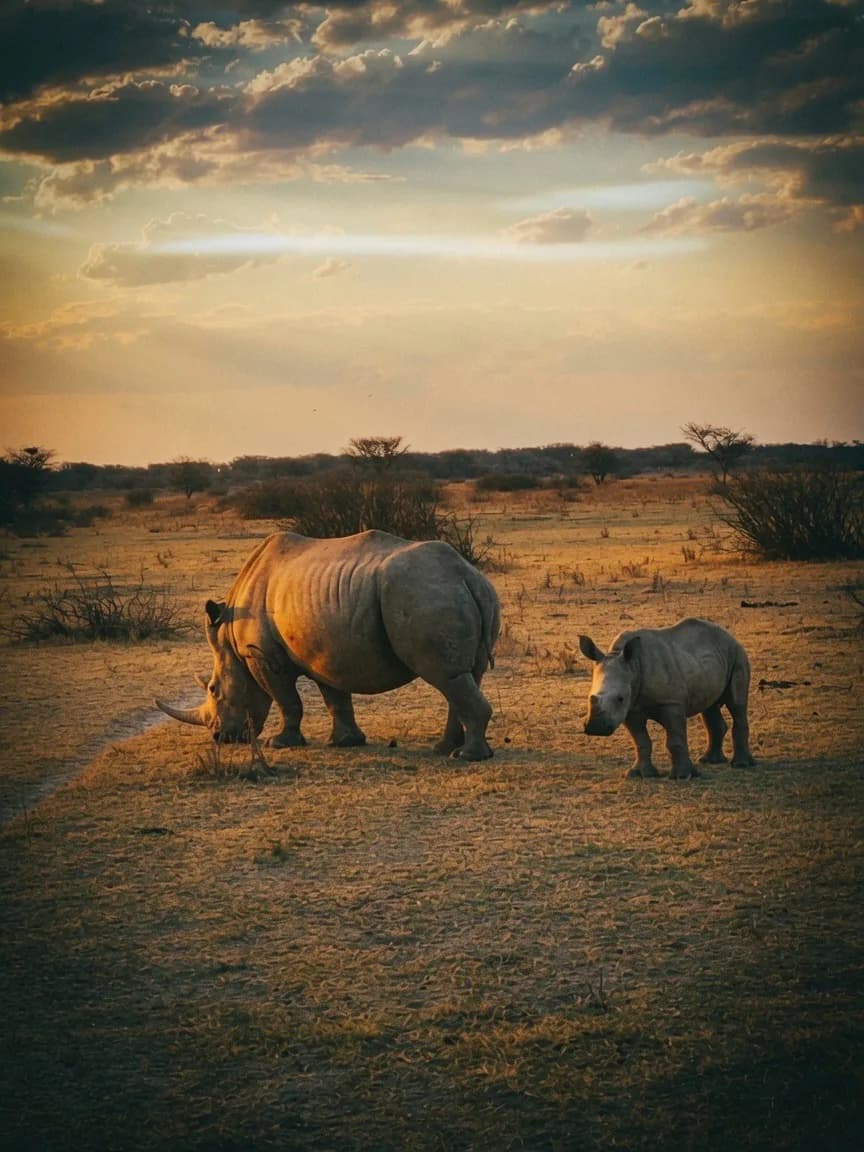
Four white rhino now stand on communal grazing land in Tsholotsho, guarded by scouts from the villages that gave up the ground. What that proves, and what it doesn't.
Drive south-east off the Hwange boundary and the country barely changes. The same teak scrub, the same grey Kalahari sand that holds a track for days, the same thin cattle standing in the shade of the same camel thorns. What changes is the paperwork. Cross that line and you are no longer in a national park; you are on communal grazing land in Tsholotsho, which belongs to the people who live on it.
There are four white rhino out there. That is the whole population, and it is the most interesting thing happening in Zimbabwean conservation right now — not because four is a number worth celebrating, but because of whose land they are standing on.
Hwange used to have white rhino. Depending on which account you read, the population peaked somewhere between 100 and 120 animals in the 1980s. Then it went, the way most Zimbabwean rhino went — to organised poaching through the 1990s and into the 2000s. The initiative's own history puts the last white rhino sighting and killing in 2007; Imvelo's account has the population eradicated by the early 2000s. The sources disagree on the date. They agree on the outcome.
For the better part of two decades there were no white rhino in the Hwange ecosystem at all.
In May 2022, two white rhino were released into the Ngamo Rhino Sanctuary. In September 2024, two more went into a second sanctuary at Mlevu. Together the two sanctuaries run to about 12 square kilometres. A third has been fenced and built, and is waiting on access before it takes animals.
None of that is on park land. It is on ground that the surrounding communities set aside from their own grazing, which is a genuine cost in a district where cattle are savings. Imvelo Safari Lodges, which runs the Community Rhino Conservation Initiative, describes it as a world first for white rhino — the species established on communal land rather than inside a protected area. We have not been able to independently confirm that claim, and it is the sort of superlative that tends to have an asterisk somewhere. The underlying structure holds up regardless.
The animals themselves came as donations. Two were given by Paul Tudor Jones, who founded the Malilangwe Reserve in the south-east Lowveld — the property whose rhino programme is usually held up as the country's benchmark.
Like the look of this?
The rhino are watched around the clock by the Cobras Community Wildlife Protection Unit: more than 40 scouts, recruited and paid from the villages next door. Their brief runs wider than rhino. They work on human-wildlife conflict, fire, and conservation education, which in a district where an elephant in the maize is a real economic event matters more than it sounds.
This is the load-bearing detail. A sanctuary guarded by outsiders is a fortress, and fortresses in communal areas tend to acquire enemies. A sanctuary guarded by the neighbours' sons is something else — and it is the difference between a project the community tolerates and one it has a stake in defending.
Travellers staying at the Imvelo camps pay a fee to walk in and see the rhino. The initiative states that all of the funds the rhino generate go back to the communities. In practice that has paid for the Ngamo clinic — building, staff salaries, transport, medicine — along with boreholes, community gardens, and an annual free eye and dental clinic.
It is worth being precise about the mechanism, because it is unusual. The rhino are not a tourist attraction that happens to fund good works nearby. The rhino are the community's asset, on the community's land, generating the community's income. Take the tourists away and the arithmetic collapses, which is the honest vulnerability in the model. But so long as people come, the incentive points the right way — for once.
Four animals across 12 square kilometres is a demonstration, not a population. It is not a viable breeding group, it is not resilient to a bad year, and the stated intention to bring in black rhino remains an intention. Anyone telling you that rhino are back in Hwange is running ahead of the facts.
What has been proved is narrower and more useful: that communal land can hold white rhino, that villages will part with grazing for them if the terms are right, and that scouts drawn from those villages will keep them alive. Those were the open questions. They are now answered, on a small scale, with real animals.
Whether it becomes a population depends on land, money and time — none of which are secured. We would rather say that than pretend otherwise.
The rhino walks run from the Imvelo camps on the south-eastern side of the ecosystem. Camelthorn Lodge sits in the Tsholotsho communal area alongside the sanctuary and is the property in our collection most directly tied to this work — staying there is how a traveller ends up funding it, rather than merely reading about it.
If you are in Hwange proper and want to build the rhino walk into a wider week, The Hide sits on a private concession inside the park, Somalisa Camp is in the acacia grove in the centre, and Linkwasha Camp holds the eastern private wilderness area. None of the three are part of the initiative, and we would not suggest otherwise.
For how this sits against the rest of the country's rhino work — Malilangwe, Gonarezhou, Matobo, Matusadona — see our note on Zimbabwe's rhino recovery.
Figures here are drawn from the Community Rhino Conservation Initiative and Imvelo Safari Lodges' own published material, cross-checked against trade reporting, and were current in August 2026. Rhino numbers on the ground change; the locations of sanctuaries are deliberately imprecise in all public accounts, including this one.
